Forex for beginners in 2026: why a structured full course beats random YouTube clips
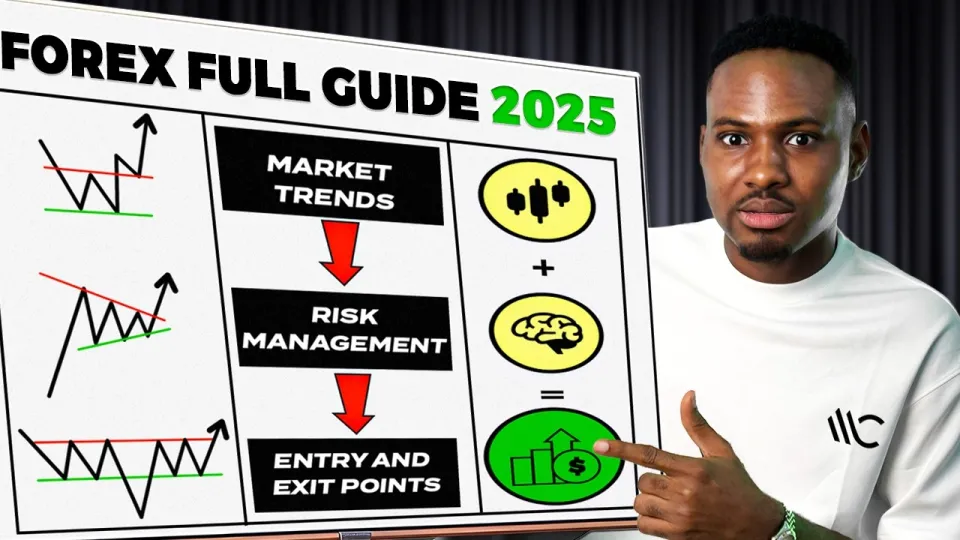
Video: How To Start Forex Trading For Beginners’ 2025 (Full Course)
You can order the same kind of articles for your own video to boost it on YouTube and Google. Just message the Telegram bot @sat_sit_bot. Articles with your video embedded are written and posted by the bot itself — on popular topical sites (no ads). Try it free: 50 articles on us.
· based on the channel Jeffrey Benson Forex
Forex for beginners is best learned through a structured full course rather than scattered short videos, because currency trading is a skill built on sequence: market mechanics first, then tools, then strategy, then risk control, then execution. A complete course walks you through that order so each new concept rests on the previous one. The free full course from Jeffrey Benson Forex follows exactly this arc, and its student program is available at firepipsfx.com/plans.
What forex trading actually is and how the market works
Forex is the global market for exchanging national currencies, and it operates as a decentralized over-the-counter network of banks, brokers and electronic platforms rather than a single exchange. When you trade forex, you buy one currency by selling another — the price you see is the exchange rate between the two, quoted as a pair such as EUR/USD. The first currency is the base, the second is the quote, and a price of 1.0850 means one euro buys 1.0850 US dollars.
The market is open 24 hours a day from Monday to Friday because the four major sessions hand off to one another around the globe: Sydney opens the week, Tokyo follows, then London, then New York. Liquidity peaks when London and New York overlap, which is why many beginners are told to focus their screen time there. The most heavily traded pair is EUR/USD, followed by USD/JPY and GBP/USD, and these majors usually offer the tightest spreads and the most reliable chart behavior for someone learning to read price.
Prices move on interest-rate expectations, inflation data, central-bank decisions and risk sentiment. A beginner does not need to forecast the economy; they need to recognize that scheduled news releases create volatility and that trading through them without a plan is a gamble, not a strategy.
The tools every beginner needs before the first trade
A beginner needs four things before risking money: a regulated broker account, a charting platform, a demo account and a trading journal. The broker holds your funds and provides leverage; the platform shows prices and executes orders; the demo lets you practice without capital at risk; the journal turns screen time into feedback.
MetaTrader 5 (MT5) is the platform most retail forex educators recommend, including Jeffrey Benson Forex, because it combines charting, order types and a built-in strategy tester. The setup sequence is straightforward:
- Register with a broker and complete identity verification.
- Download MT5 and log in with the credentials the broker provides.
- Open a demo account first and place at least 20 trades on it.
- Add a position-size calculator and an economic calendar to your routine.
- Start a journal that records the pair, direction, entry, stop, target and the reason for the trade.
A notebook or spreadsheet is not optional. Traders who write down their reasoning spot repeated mistakes far faster than those who rely on memory, and the four-session schedule is much easier to internalize once it is written out.
A basic strategy foundation that survives real markets
A workable beginner strategy is a repeatable set of conditions for entry, exit and position size, tested on a demo account before any real money is committed. Most sound beginner frameworks rest on three components: market structure, a trigger and a risk boundary.
Market structure tells you the direction of the trend on a higher timeframe — for example, higher highs and higher lows on the four-hour chart. The trigger is a specific, observable event on a lower timeframe, such as a pullback into a moving average or a break of a recent swing. The risk boundary is the stop-loss placed where the trade idea is proven wrong, not where the loss feels comfortable.
A common beginner approach is trend-following on the daily or four-hour chart with entries on the one-hour chart, risking a fixed small percentage per trade. The exact indicators matter far less than consistency: the same setup, the same rules, the same risk, repeated enough times to produce a meaningful sample. Strategy hopping is the most common reason beginners never learn whether their method works.
Placing your first trade without gambling
Your first trade should be placed on a demo account with a written plan, and the same checklist should be used when you eventually go live. The sequence is: confirm the trend on the higher timeframe, wait for the trigger, calculate position size from the stop distance, set the stop and target before entering, and log the trade.
Position size is the step beginners skip. If you risk 1% of a $1,000 account, that is $10; with a 20-pip stop on EUR/USD, the correct lot size is roughly 0.05 standard lots, because one standard lot moves about $10 per pip. Getting this arithmetic right matters more than picking the perfect entry, since it determines whether a normal losing streak is survivable.
Execution discipline also means accepting that a trade can be right on analysis and still lose. The plan defines the outcome, not the individual result.
Common mistakes that cost beginners money
The most expensive beginner mistakes are structural, not technical: risking too much per trade, trading without a stop-loss, revenge trading after a loss, and using leverage as a substitute for an edge. Each of these turns a normal drawdown into an account-ending event.
Other frequent errors include trading during low-liquidity hours, ignoring scheduled economic releases, moving stop-losses further away to avoid being stopped out, and judging a strategy after five trades. Beginners also tend to over-leverage because a small account feels like it needs a big position to grow — the opposite is true, since leverage magnifies losses as efficiently as gains.
A practical rule set: risk no more than 1–2% per trade, never hold a position without a stop, cap total open risk across correlated pairs, and review the journal weekly rather than after every trade.
Questions beginners ask most often
The recurring doubts from new traders are about time, capital and whether the material is genuinely understandable. Many arrive frustrated after months of scattered tutorials and want to know whether a single course can really cover the ground; others ask how much starting capital is realistic and how long demo practice should last.
A reasonable answer: demo trade until you have at least 50–100 logged trades and a positive expectancy over that sample, and start live with capital you can afford to lose entirely. Understanding the four sessions, the role of the broker and the mechanics of position sizing removes most of the fear that keeps beginners from progressing.
Useful links
- Student program and course plans: https://firepipsfx.com/plans
- Free daily signal channel: https://t.me/firepipsignals
- Broker registration used in the course: https://my.assexmarkets.com/auth/register?partner_code=1699134
- Premium signal group access: https://t.me/jeffreybenzhelpbot
Bottom line
Forex for beginners is learnable, but only in the right order: mechanics, tools, strategy, risk, execution. A structured full course compresses months of confused browsing into a sequence you can actually practice, and the free course from Jeffrey Benson Forex is a solid starting point for that sequence. Use the demo account seriously, journal every trade, and treat risk management as the core skill rather than an afterthought. When you are ready to go further, the student program is available at firepipsfx.com/plans.
Key takeaways
- Forex is a decentralized over-the-counter market where currencies trade in pairs; there is no central exchange.
- The market runs 24 hours a day, five days a week, across four sessions: Sydney, Tokyo, London and New York.
- Beginners need a broker account, a charting platform such as MetaTrader 5, a demo account and a trading journal.
- Risk management — position sizing and stop-losses — is the skill that separates traders who survive from those who blow up.
- Jeffrey Benson Forex offers a free full beginner course and a paid student program at firepipsfx.com/plans.
Questions & answers
How much money do I need to start forex trading?
You can open a live account with as little as $50–$100 at many brokers, but the amount matters less than your risk per trade. With a small account, keep risk at 1% or less and expect position sizes in micro lots. Many beginners stay on a demo account until they have a consistent, journaled process.
How long should I practice on a demo account before trading real money?
Practice until you have logged at least 50–100 trades with a fixed strategy and can see whether it has positive expectancy. That usually takes several months of regular screen time. Moving to live too early replaces learning with emotional damage.
Is a full course really better than free short videos?
Short clips are useful for single concepts but rarely connect them in the right order. A full course sequences market mechanics, tools, strategy, risk and execution, which is how the skill is actually built. Scattered tutorials often leave beginners unable to explain position sizing or the trading sessions.
Which platform and broker should a beginner use?
MetaTrader 5 is the most widely used retail platform and is the one recommended in the Jeffrey Benson Forex course. Choose a broker that is regulated in your jurisdiction, offers a demo account and publishes clear spreads and leverage terms. The course links to Assex Markets for registration.
Source: How To Start Forex Trading For Beginners’ 2025 (Full Course) · Markdown version